
Surat Fashion Sale
Connecting the storefront to the systems behind the business.
The challenge
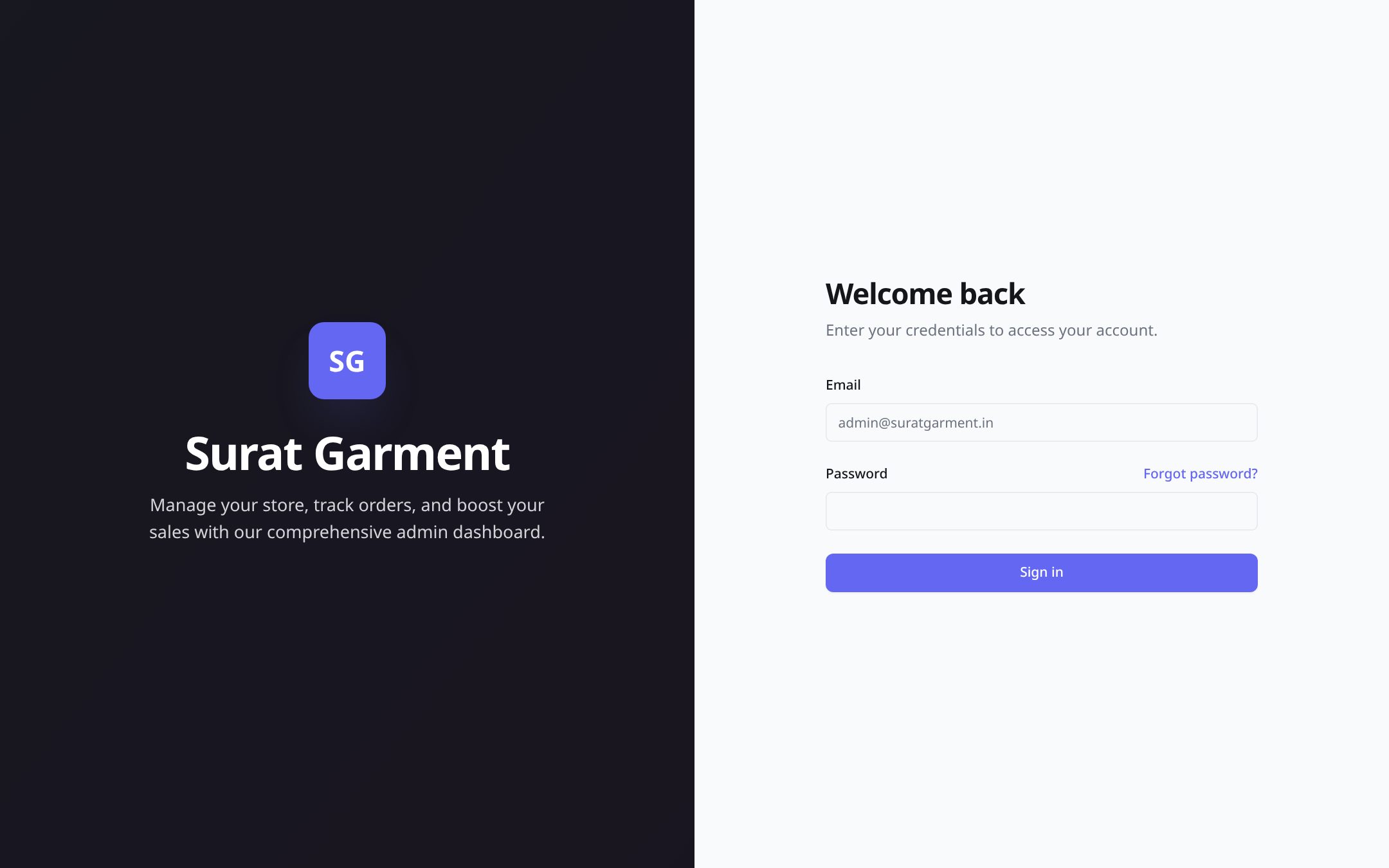
A garment commerce project where the customer-facing sale experience is paired with an operational admin system. The live entry point is a secured admin panel — described on its own sign-in screen as a dashboard for managing the store, tracking orders and driving sales — which places the work squarely in the space between commerce and operations.
Garment and textile businesses run on stock movement, order handling and margins measured in days. A storefront alone does not solve that; the orders it creates have to land somewhere an operations team can actually work.
Exact project contribution
Commerce and admin interfaces, order-management screens and dashboard structure.
Public secured entry point; internal operational screens are not shown.
Scope
Project summary
- Business challenge
- Customer orders needed an operational interface where the business could manage and track store activity.
- Solution
- Commerce and admin interfaces, order-management screens and an authenticated dashboard structure, scoped to the stated contribution.
- Business outcomes
- The secured operational entry point is public evidence of the store-management interface. Internal inventory accuracy and sales improvements are not publicly verified.
- Technologies
- Team expertise: React.js · Kafka · Java · Spring Boot · PostgreSQL. Project-specific technology assignments remain to be confirmed.
- Measured impact
- Metrics awaiting confirmation; no numerical results are claimed.
The approach
Model the flow end to end: what the customer does, what that creates operationally, and who acts on it next. Interfaces were then designed per role — a public commerce surface for customers and a focused, role-restricted dashboard for the team.
The customer experience
The customer side is built for browsing and buying: product presentation, clear pricing and a short path to placing an order.
The business system
The admin side is an authenticated dashboard for store management and order tracking. Access is gated at sign-in, so the operational interface stays private to the business.
The connection
Customer → e-commerce → orders → business operations → inventory. Every step in that chain is a place where data has to move without a person re-typing it, and that chain is what this project is about.
What we built
Team experience across the commerce and admin interfaces, order-management screens and the operational dashboard structure. We describe the system's shape rather than claiming specific ERP modules that are not publicly verifiable.
How the pieces connect.
- 01
Customer
Browses and buys
- 02
E-commerce
Storefront and checkout
- 03
Orders
Captured with structure
- 04
Business operations
Confirm, pick, dispatch
- 05
ERP / Inventory
Stock and records stay accurate

Order management interface placeholder
Representational system diagram. This interface runs behind authentication, so its structure is drawn rather than shown.
- 01
Trigger
- 02
State
- 03
Logic
- 04
Surface
What this demonstrates.
Commerce connected to operational systems
Role-based admin interfaces
Order and inventory workflow thinking
Authenticated business dashboards
Verification
Claims on this page are limited to the contribution stated above. Interfaces behind authentication are drawn as representational system diagrams, never reconstructed as proof.
Next case study
CFD